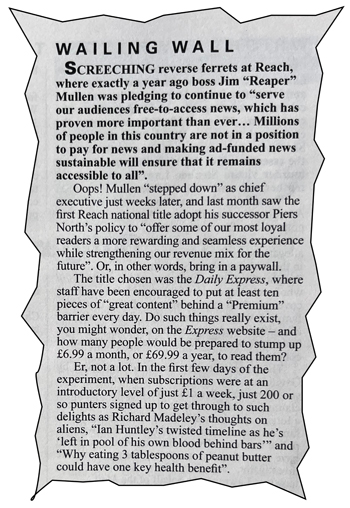
A few wry media eyebrows were raised when it emerged that Reach plc was finally introducing online paywalls at its titles. “Screeching reverse ferrets at Reach” was how Private Eye described the move in the first five words of an article headlined ‘WAILING WALL’ on page 10 of issue 1670, dated 6 to 19 March 2026, (ironically only available in print). But why the sarcasm?
The background
Reach’s new online editorial subscriptions began at the Manchester Evening News (MEN) in November last year, described by HoldtheFrontPage as a ‘part paywall’ approach. This was quickly replicated at the Liverpool Echo, Wales Online, LeicestershireLive, ChronicleLive in Newcastle, and then BirminghamLive. National titles followed suit at the Daily Record and Express.co.uk, online home of the Daily Express and Sunday Express, with BelfastLive and YorkshireLive becoming the ninth and tenth paywalls by Easter.
Reach is not the first to try paywalls, of course. National brands including the Daily Telegraph, The Times and Financial Times have long been subscription-only online, and many other publishers’ regional titles have adopted paid-for approaches in the last decade. What’s so different about Reach, the UK’s largest news publisher, is that this is a major change in strategic direction.
As Private Eye pointed out, it was only in March last year that Reach’s former chief executive, Jim Mullen, insisted that “free-to-access” news was “more important than ever”, in a world of “social unrest caused by disinformation”. He said: “Millions of people are not in a position to pay for news, and making ad-funded news sustainable will ensure it stays accessible to all.”
This stance shifted when Piers North replaced Mullen as chief executive, announcing new paywalls would “offer some of our most loyal readers a more rewarding and seamless experience”. North explained how Reach’s huge audience meant “moving even a fraction to paid will be significant ... strengthening our revenue mix for the future.”
To appreciate the enormity of this transformation, we should first recall the previous views of David Higgerson, chief content officer at Reach. Because, until now, Higgerson, the company’s digital editorial boss stretching back to Trinity Mirror days nearly 20 years ago, regularly championed free online access. A prime example was when senior industry figures called for paywalls more than a decade ago.
Nigel Lowther, then editor and owner of the independent Cleethorpes Chronicle, told HoldtheFrontPage.co.uk in 2013: “Why should we put all our stories online, which takes a lot of effort and journalistic resources, for free?” Paul Robertson, ex-editor of the Newcastle Chronicle, mirrored this view by referring to “the utter madness of uploading all content online for free” in his chapter of What Do We Mean By Local? (Arima, 2013). And the late Robin Burgess, then owner of Cumbrian Newspapers, told the 2014 Society of Editors conference: “We can’t continue giving our content away. The reader must pay!”

In direct response, Higgerson wrote on his WordPress blog in August 2014: “The idea that because it costs money to generate content people should pay for it is a comforting view for journalists to hold, but it’s also a blinkered one. […] Just because we can attach a value to what we produce doesn’t mean the audience we want to appeal to feels the same. […] Making all your content available on the platform the audience is clearly saying it prefers isn’t madness at all – it’s the bare minimum you can do to help your brand survive.”
Higgerson underlined these anti-paywall views in The Media Leader in November 2014, writing that “telling people they can get the truth only if they pay” is only going to “risk ill-informed resentment taking society to a much darker place”. He added: “That’s why free-to-access news and information, that is reliable and trusted, is so important.” Even as recently as September 2023, Higgerson remained defiant against “the old argument of ‘the reader must pay’”. Writing in Press Gazette, he said: “Must they? A decade of evidence shows that, in the UK, and in the main, they won’t […] it feels like a backward step.”
The last two years, of course, have seen drastic changes in Meta’s algorithms, and new AI overviews for Google searches have led to fewer clicks through to journalism, with negative knock-on effects for online views and advertising rates. With all that in mind, here’s how Higgerson now explains Reach’s late conversion to paywalls.
The interview…
Q: What’s driving Reach’s new paywalls?
A: “Good journalism costs money to produce and this either comes from advertising or from readers. The premium offering allows us to give readers options. Some readers value a cleaner reading experience and are willing to pay for this, on top of access to exclusive content. Ad-supported journalism is still important and will form the core of our business model for years to come. But it’s no secret that tech platforms can be volatile, and this is a way to build an additional and steady revenue stream. At our scale, even a modest conversion rate can be sizeable. External data suggests more people are prepared to pay for news – from 6 to 10%. And we were also hearing this from some readers.”
Q: What’s been readers’ response?
A: “Largely positive, and where readers have questions, our editors have been hands-on about explaining why. We reach just under 30 million people a month with local news, and the vast majority won’t want to pay, and in some cases have been disappointed at being asked to pay. There’s an honest conversation to be had in those cases.”
Q: What does the new ‘part-paywall’ model mean?
A: “Three main categories. Always premium: this is constantly changing based on reader feedback, insights from our data, and individual editor choices. But our starting point is that deep, engaging journalism is most likely to be treated as premium. Metered: Most of our journalism will fall into this category. If you’re a frequent flyer, you’re likely to be asked to pay after reading a certain number of articles. Always free (not premium and not subject to meter): usually public interest, standard news reporting. Most breaking news remains free for all, so without the meter, at editors’ discretion.”
Q: Is this new strategy a U-turn?
A: “There was a really simplistic, romantic view in local journalism about ten years ago that if we told the reader they should pay, they would do so in the volumes we had buying the newspaper. Local publishers who went down this approach did themselves serious damage. I argued against because I could see people voting with their feet – they were joining Facebook community groups, engaging on Twitter, sharing stuff on bulletin boards and so on.
“Our challenge was to be relevant to people in their digital lives, and that takes time. BirminghamLive is now read by one third of the West Midlands, the MEN by half of Greater Manchester, ChronicleLive by 60% of people in Newcastle. In new cities for us, like Belfast, we’re now the biggest publisher, reaching 60% of the local market. That’s made us relevant to people where they are online, and that opens the door to talking about paying for journalism.
“It’s meant we’ve had to change a lot, understand what people really value, and where they’re not valuing what we think is important, we invest time in building relationships so people do care. We have experimented with pay models in recent years and were pleased with the success we saw. However, I was always mindful of asking newsrooms to do too much, especially when the most immediate opportunity to sustain local journalism was via platforms such as Google and Facebook, both which continue to be important.
“What’s clear is, to make this work, you need scale. And that’s what we have – but within that scale we have north of three million very loyal readers in the UK who value what we do, and in many cases have asked whether we’d charge for an ad-lite experience. Editors are rightly proud of the journalism their teams do. Talking to readers about how they can help to fund that is much easier when we’ve been a constant in their digital lives for years.
“The power of scale is still undeniable. This is why the MEN is able to campaign and make a difference, for example with Awaab’s Law [legislation compelling social landlords to address hazards like damp within strict timeframes, following two-year-old Awaab Ishak’s death in Rochdale]. If we look at a pure paid model, we feel we would lose something really important and integral to what we do.
“What we’re hoping to do now is serve that scale, serve people who would not afford to pay for news, while also offering readers some choice if they choose to pay, ensuring an additional and steady revenue stream.”
Q: How might paywalls develop, and how can readers not paying still access news?
A: “Wherever we get to with that sliding scale of free / metered / premium, we want to and need to keep the shop windows open. We’re not in the business of turning people off from even checking out our content. In a world where 90% say they won’t pay, I think we have to ensure we create a system where reliable news isn’t the preserve of those who can pay and will pay, because if that happens, society will be the worse for it.”
The paywall experience
After £1 for the first month, Reach’s ‘premium’ subscriptions costs £4.99 per month for each regional site, and £6.99 a month for Express.co.uk. A Reach spokesperson said: “This may be something we experiment with as we continue the roll-out.”
As a daily reader of BirminghamLive since its birth, it was easy for me to compare its ‘free’ and ‘paid-for’ models. I’ve written previously about how intrusive online adverts can drive readers mad. Constantly moving and expanding pop-up adverts that push and pull articles away from sight have often made me give up. Even when I’ve badly wanted to read an entire article, the page has regularly closed, meaning I’ve had to start again. I’ve sometimes wondered if this was deliberate to create multiple clicks from each reader wanting a single article!
But as a ‘premium’ member, my BirminghamLive experience has been a joy: a clean, almost uninterrupted read. Even the single initial advert I faced per visit was easy dispensed with. It has revitalised my reading, making it easier to duck ‘clickbait’ content to find some great journalism. There’s also a call to action by Reach at the end of each article: ‘ENJOYED THIS STORY? Choose BirminghamLive as a ‘preferred source’ on Google News for quick access to the news you value’, with a huge ‘Add as a preferred source on Google’ button to click. This is a smart attempt to outfox those wily but often inaccurate AI answers to Google searches. (Full disclosure: I was granted free access to Reach’s ‘premium’ status to help research this article.)
Will it work? I hope so. Readers once paid for quality journalism, so perhaps they should again. It’s a tough challenge simply because Reach gave online content away for so long. If you’ve always had it free, why pay? But the considered way Reach is approaching the change makes sense. Some free content remains, but if readers want to access everything then they must pay ‘premium’ fees. My advice is for Reach to holler testimonials about the ad-lite, extra content experience from the rooftops. And maybe keep it at £1 for longer, to persuade more readers to give it a whirl.
This article was first published in InPublishing magazine. If you would like to be added to the free mailing list to receive the magazine, please register here.