Q: What is best practice now?
A: Treating workflow as a product is the new best practice for publishers.
The phrase multichannel publishing has appeared in media strategies for more than a decade. Yet many editorial teams still create content for a single legacy channel – typically print or web – and then manually adapt it for newsletters, social media, apps, and other platforms. This approach is slow, costly, and increasingly incompatible with today’s audience behaviour.
When addressing this challenge, publishing leaders typically fall into two schools of thought: improving process efficiency or adopting AI as a cure-all. While both have value, neither addresses the deeper operational issue. The real challenge is building publishing operations that can continuously adapt as audience expectations, business models, monetisation strategies, regulations, platforms, and technologies evolve simultaneously.
The answer requires a fundamental shift in mindset. Publishers should stop treating workflow as a static process and start treating it as an evolving product. The objective is not to design and implement the perfect workflow, but to create an operational framework capable of changing as quickly as the business it supports.
The core shift: process vs product
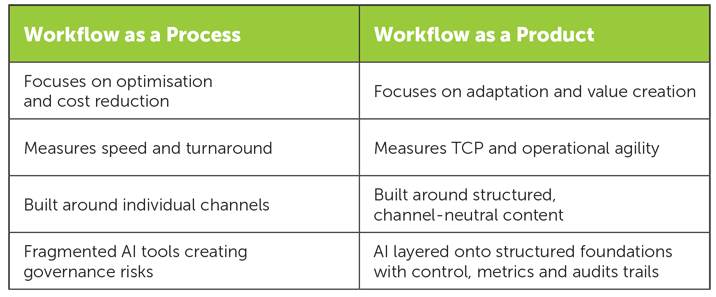
Traditionally, workflow has been treated as a static pipeline where processes are designed, standardised, and repeated to maximise efficiency. In a rapidly changing media environment, however, rigid processes block innovation. Managing workflow as a product introduces dedicated ownership, a clear optimisation roadmap, and performance metrics aligned directly to business outcomes. In practice, a product-mindset requires continuously balancing three critical dimensions:
- Technology (feasibility): Ensuring systems are agile, modular, and structurally capable of automated delivery.
- Customer (desirability): Ensuring workflows provide editorial teams with the speed and flexibility to experiment with direct-to-consumer propositions, especially in a zero-click era where audience engagement is hyper-dynamic.
- Business (viability): Ensuring the operation remains financially sustainable.
The Total Cost of Publishing (TCP) becomes essential here, because it represents the complete resource investment required to create, enrich, manage, and distribute content throughout its entire lifecycle. Continuous analysis of TCP drives the business viability component, verifying that expanding into new channels remains profitable rather than financially draining.
Current best practice: channel-neutral and structured content
Treating workflow as a product requires a channel-neutral content architecture, often referred to as structured authoring or content-first publishing. Instead of creating content for a specific platform and adapting it later, content is created once as a collection of structured components – headlines, standfirsts, body sections, captions, pull quotes, metadata, and rights information. Publishing systems then automatically assemble and distribute these components across channels.
The gold standard
The goal is not to write for the website and then repurpose content for other channels. True efficiency lies in creating channel-neutral, structured content once and letting a smart publishing infrastructure handle the distribution. Crucially, this flexible structure removes technical barriers, making content instantly available to every team across the organisation so they can freely experiment with innovative ways of engaging audiences – whether launching a micro-campaign, testing a new digital format, or feeding an AI application – without the need to construct even a single new parallel workflow.
Historically, this approach was largely confined to large news organisations and academic publishers. The BBC, for example, has progressively evolved towards a structured content architecture in which editorial content and metadata can be reused across web, mobile, voice, and international channels, while scientific publishers have relied on XML-first workflows to feed multiple platforms simultaneously.
Today, these practices are becoming essential across consumer magazines, trade publications, and regional publishers due to three major market pressures:
- Audience fragmentation: Audiences consume content through websites, newsletters, apps, podcasts, social media, and connected television. Publishers that efficiently distribute content across all these channels without duplicating effort gain a significant competitive advantage.
- Resource constraints: Editorial teams must produce more content with fewer resources. Manually adapting content for each platform is no longer sustainable; channel-neutral workflows increase publishing capacity without increasing headcount.
- The rise of AI licensing: The emergence of commercial AI licensing markets is creating entirely new revenue opportunities. However, these opportunities depend heavily on structured, rights-managed content assets.
The commercial catalyst: the UK AI licensing market
The UK publishing industry is rapidly moving beyond defensive discussions about AI towards creating commercial licensing frameworks. In early 2026, Publishers’ Licensing Services (PLS) launched a collective AI licensing scheme designed to provide AI companies with authorised access to publisher content. At the same time, leading organisations including the BBC, Financial Times, Guardian, Sky News, and Telegraph launched SPUR (Shared Publisher Understanding and Rights) to develop technical and commercial standards for AI access to journalism.
Why structured content matters
These initiatives rely on content being discoverable, rights-cleared, and machine-readable.
To participate effectively, publishers must be able to identify content by subject, date, format, territory, and rights status. This requires structured content models and complete, accurate metadata.
Publishers relying on legacy CMS platforms, unstructured HTML content, or disconnected rights spreadsheets will struggle to participate in these markets at scale. In practice, an inflexible editorial workflow becomes a commercial bottleneck. This is why a product-mindset toward workflows is a necessity; it turns system refinement into a core capability, elevating metadata and rights capture at the point of creation from a mere operational advantage into an urgent commercial priority.
Q: How do you see it changing in the future?
A: Organisations that treat workflow as a product are better positioned to capitalise on three major industry shifts.
- AI-assisted structured authoring: AI should be viewed as an optimisation layer rather than the foundation of a content strategy. In modern editorial environments, AI tools excel at executing discrete, high-volume tasks: suggesting metadata and taxonomy tags, generating headline variations, identifying rights conflicts, and accelerating content classification. However, these capabilities only work effectively when content is treated as structured data rather than static text. Applying AI to poorly organised content simply accelerates inconsistency at scale. The sequence is crucial: first establish the content model and workflow, then apply AI.
- Simultaneous multichannel publishing becomes standard: The vision of ‘write once, publish everywhere’ is moving from aspiration to operational reality. As headless CMS platforms and structured publishing tools become more accessible, publishing for a single channel first will increasingly be viewed as outdated. This shift does not change journalism. Reporting, investigation, editorial judgement, and storytelling remain unchanged. What changes is how content is organised and delivered. Writing in structured components, applying metadata at creation, and considering multiple channels from the outset will become standard editorial practice.
- Rights workflows become editorial workflows: As AI licensing revenues grow, rights management can no longer remain a post-publication administrative task. Publishers must capture rights information – such as AI training permissions, syndication rights, and territorial restrictions – during the content creation phase and ensure it remains attached to that content throughout its lifecycle. This requires close collaboration between editorial, legal, and technology teams.
The competitive advantage is structural
Publishers face two deeply interconnected challenges: serving fragmented, ‘zero-click’ audiences while simultaneously capitalising on commercial AI licensing markets. Both demands share a singular foundation: structured, channel-neutral content models that treat information as data rather than static text.
Media organisations that treat their workflow as an evolving product rather than a fixed process, will inevitably break down the technical barriers slowing down their teams. This structural shift turns ongoing system refinement into a core capability – allowing publishers to launch direct-to-consumer propositions, enter new licensing markets at scale, and capture clean metadata at the exact point of inception.
Building this agility does not require a huge technology budget. It does demand disciplined workflow design, clear data modelling, and an absolute commitment to ongoing iteration. The operational shift is significant, but as AI-driven business models continue to reshape the industry, the commercial returns will be far greater.
Q: What are your three top tips?
To transform workflow from a static process into an adaptive product, publishers should focus on three structural changes.
1. Design authoring around components, not pages. Many editorial systems still encourage teams to think in terms of pages or layouts, reinforcing channel-specific publishing.
• Best practice action: Define a content model before selecting or configuring technology. Identify the components that make up each content type – headline, standfirst, body copy, pull quote, metadata, keywords, rights status – and ensure each exists as a separate, validated field.
Technology should support the content model, not define it.
2. Capture rights metadata at content inception. Modern licensing frameworks require immediate answers about content ownership, usage permissions, and territorial restrictions.
• Best practice action: Establish a minimum rights metadata framework that includes AI training permissions, territory restrictions, syndication rights, and license duration. Make these structured fields mandatory during the content creation phase rather than after publication.
3. Audit distribution channels before reviewing technology. Many CMS replacement projects begin by evaluating features rather than understanding how content moves through the organisation.
• Best practice action: Map the complete journey of a piece of content from initial creation across every downstream channel – including the web, newsletters, mobile apps, print, syndication, and AI licensing platforms. Crucially, include the pipelines that expose content to internal teams experimenting with direct-to-consumer propositions or optimising for ‘zero-click’ AI environments. Identify where content is reformatted manually, where metadata is re-entered, or where duplicate versions are created. Often, the true bottleneck isn’t your CMS – it’s the flawed workflow and content model feeding into it.

About WoodWing
WoodWing empowers publishing ecosystems by uniting technology with deep industry expertise. For 25+ years, we’ve helped teams create, manage, and deliver content across print and digital channels with greater efficiency and consistency. Our portfolio spans multi-channel production, digital assets, quality, knowledge, and information management. Founded in 2000, we operate globally from our headquarters in the Netherlands.
Web: www.woodwing.com
This article was first published in Issue # 1 of Best Practice in Publishing, a new publication from InPublishing. Click here for links to the other ‘best practice’ articles from the publication.