Every year, Good Food magazine surveys the nation’s eating habits with YouGov. This year, one theme stood out: people were feeling overwhelmed.
“That’s due to the amount of recipe content online and conflicting food advice,” says Emma Hartfield, Good Food’s health editor. Emma and her team weren’t overly surprised. They knew there was a demand for content that could cut through the noise around what we eat.
A different direction
In January, Good Food launched Good Health, following a soft launch in September.
Health had always been part of the brand. “Good Food was one of the first brands to include nutritional information with its recipes,” says Emma. “Our audience has always been interested in that side of things.”
When Good Food went online, health content performed particularly well. “Behind recipes, it was the vertical with the most views,” says Emma. “It even outperformed budget and family content.”
Good Health was a way to take that success further. It ties in with our changing attitude towards food and health. We no longer understand healthy food to be about weight loss. Many of us now see food as a form of lifestyle medicine.

But as more of us have become interested in what we can eat for our digestion or our sleep, there has been more misleading advice about what exactly that should be. Good Food thought it could play a role. “We felt there was a real need to help people out with the huge amount of health misinformation online, particularly on social media,” says Emma. “People trust Good Food as a brand. We felt we could build on that.”
Good Health, best understood as a sub-brand of Good Food, has a couple of key content strands. One comprises reels of recipes in the Good Food store cupboard that do something for our health (the team has 17,000 to choose from). The other examines some of the food and wellness claims taking over our algorithms: from the benefits of eating kiwi with the skin on (true) to the benefits of downing a shot of olive oil every morning (false).
While digital-first is now a given for most brands, Good Health is taking the next step: it is largely social-first. It meets its audience where it is already. Good Health not only posts first on social; it sees what people are talking about on Instagram and TikTok and reacts to it in real time.
Within months, Good Health scored its first industry triumphs: scooping Best Use of Social Media at the BSME Awards and an AOP award for Publishing Innovation: Audiences. Its follower numbers might look modest compared to Good Food – Good Health has 18,000 on Instagram and 8,500 on TikTok in contrast to Good Food’s 1.4m and 71,000 – but the publishing world has recognised that it’s doing something right.
A science-backed approach
Emma has been at Good Food for three years and works across print, web and social on Good Food and Olive, as well as heading up Good Health.
One of the first things she did when she joined was overhaul Good Food’s diet guides. “I wanted to make sure that we got the science across,” she says. “Even if a diet is helping you lose weight, how else is it affecting your body?”
The Good Health team takes a similar science-backed approach when it tackles social trends. Only one member of the Good Food staff works on Good Health full time – Melissa Kuman – and she’s a nutritionist.
For Good Health, eating well isn’t about how food makes you look. It’s about how it makes you feel. “I see a fairly unhealthy influencer segment on social media that is promoting appearance at all costs.”
Feeling good for the team means eating what they love. “Everyone on Good Health is a big foodie. We all love food and that’s what we want to get across. We’re not about cutting out certain foods. We’re about adding more of the good stuff in. Food is there to be enjoyed.”
The new healthy
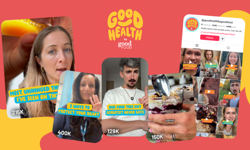
The healthy recipes the team enthuse about on their social reels often don’t seem like healthy foods at all (they post the same content across TikTok and Instagram due to limited resources). They’re definitely not conventional diet foods. There’s no sign of cabbage soup – and lemon water appears only as a hangover cure. The Good Health creators prefer sticky toffee pudding bark, a homemade chocolate bar with dates and pecan nuts (it’s clocked up 293,000 views on TikTok), and breakfast crumble with chia seeds and nuts (80,000 views on the same platform).
Recipes tend to come from the Good Food archive, says Emma, capitalising on what the umbrella brand does best (Good Food boasts 85 per cent share of search compared to its competitors). The Good Health team makes them into reels. They use the same kitchen, as well as the same video and SEO teams, allowing them to be “really connected”.
Good Health has developed distinctive formats, including Unhinged, where Deputy Health Editor Isabella Keeling examines an outlandish food and wellness claim (this summer it was footballers’ diets), and What I Eat in a Day, a reel version of the popular My Day on a Plate in many a print magazine.
Each month, they work to an overarching theme, publishing five or six videos a week. May was brain health, July was protein and August was skin health. Within this, they still cover topics such as ultra-processed food, fibre and protein because that’s what audiences tend to be interested in. In one recent video, Melissa shows what eating ultra-processed food for a day might look like and explains that it doesn’t have to be a health disaster.
The power of micro-influencers
Influencers are central to the Good Health strategy, but not in the traditional branded-content sense. They’re more like columnists. Emma repeatedly returns to the importance of selecting people whose ethos aligns with the brand’s values. “We pick our social partners really carefully and try to work with people that have the same ethos as us,” she says.
That ethos is about everything being backed up by science and about people giving their unbiased and honest opinion about things, even if there’s a lot of marketing spend behind it. Good Health tries to avoid either buying into any hype or fearmongering.

Collaborators range from established names such as Dr Alex George, the former A&E doctor and Love Island contestant, who is fronting their new podcast, to micro–influencers.
One of the biggest success stories has been Jordan Haworth, better known as Mr Gut Health, whose accessible, humorous gut-health content has become hugely popular both independently and on Good Health’s channels. His posts on Good Health get between 2,000 and 5,000 likes, but perhaps more importantly, they get strong engagement, often sparking 100 to 200 comments.
“We have been surprised at how quite a niche topic has done so well,” says Hartfield. “Do people want to hear about farting and pooping in their feed when they’re looking for food content?” Apparently so. Part of Haworth’s appeal lies in his ability to combine scientific credibility with warmth and personality. “You feel you know him,” she says. “He makes the science incredibly accessible.”
Good Health resists over-controlling creators’ output. “We started off with more guidance for our influencers, but they know better than us what works on their feeds,” Emma says. “We want their content for us to feel exactly like their own.” A range of content is essential because social success remains notoriously volatile. “Particularly on TikTok, you never know what’s going to resonate,” says Emma. “It’s impossible to predict.”
Beyond food
One of the biggest differences between the traditional Good Food brand and Good Health is that Good Health publishes general health and fitness advice. “It sprang from healthy eating,” says Emma. “We’ve just gone out on a limb a little more.” The Good Health channel on the Good Food website now includes fitness content, such as the difference between yoga and Pilates. “Fitness is further from our core remit, so it’s been harder to gain traction,” says Emma. “But we want to keep trying.”
On social, they’re working with Jess Brown, who talks about the virtues of slow running. “I really like what she stands for: doing exercise because it makes you feel good,” says Emma. “She’s so personable and warm as well.” On TikTok, Jess has nearly 13,000 followers. On her running account on Instagram, it’s under 1,000.
“We’d love to find somebody before they get big and be with them on that journey,” says Emma. “That’s happened to a certain extent with Mr Gut Health. He had a decent following before working with us, but I think he’s probably taken off since then.” Mr Gut Health now has 395,000 followers on Instagram and 253,000 on TikTok, where his posts have had 2.7m likes.
“We’re constantly looking for people and hoping to strike lucky. But we’re also really glad if we can find somebody whose message we agree with and just think should be out there,” she adds.
In a mass of overwhelming content, Emma is more interested in engagement than size. “We don’t just do things for clicks and likes,” she says. “We want to give people information in a way they find fun and useful.”
Not that she doesn’t want Good Health to grow. “Our audience is primarily UK-based because we’re tapping into topics that are relevant for them, but we don’t mind where people live,” she says. “We want to keep building our audience and getting our name out there, so we have the same recognition as Good Food. That’s our dream.”
This article was first published in InPublishing magazine. If you would like to be added to the free mailing list to receive the magazine, please register here.