The Reuters Digital News Report 2026 portrays a challenging picture for news publishers in many respects. Interest in news has fallen significantly since the pandemic and traffic to owned news websites and apps continues to decline. On the commercial front, in addition to well-known uncertainty about the outlook for advertising, the proportion of people who say they pay for access to online news appears stuck at about 17% globally (10% in the UK).
But there is one segment of the news industry bucking these trends: news influencers, also known as news creators (this article uses the terms interchangeably). Their growth has been rapid in recent years, but how should the existing news establishment regard them? Are news influencers just another threat in the ongoing battle for the survival of the publishing industry, or are they breathing new life into the sector?
News influencers now play a visible role in the news landscape globally: 27% of people around the world say they encountered news content from news influencers or creators in the past week. This figure reflects consumption of content from creators dedicated to producing news-related content (eg. Hugo Décrypte in France or Philip DeFranco in the US). If we also include consumption of content from creators who are more broadly focused on entertainment but sometimes talk about current affairs, the figure increases to 46%.
In countries where the profile of established media is lower and social media and video networks like YouTube, Instagram and TikTok are more popular, we see high levels of audience usage of these news-focused creators. One-third of Brazilians get at least some content from these news creators, and in Thailand, the figure rises to almost half.
The UK is part of a group of countries where these news creators are not as prominent. This group of countries, mainly in Europe, tends to exhibit relatively greater reliance on established commercial and public service news brands with a smaller role for indirect news discovery on social media platforms and video networks. Nevertheless, 18% of UK respondents say they get content from news focused creators each week and this figure rises to 25% when news content from creators who occasionally talk about the news is taken into account. The three most frequently mentioned news creators in the UK are Dylan Page (known as News Daddy), Meidas Touch (a US-based creator outfit) and news-explainer specialists TLDR News. Dylan Page has the biggest worldwide audience of any British news creator with more than 19 million followers on TikTok.
What do audiences especially like about creator content?
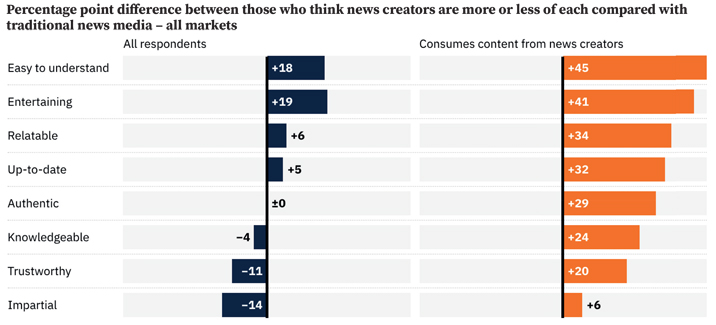
Given the rapid rise of creators, news publishers want to know what can be learned from them to increase the appeal of mainstream news to audiences, especially younger ones. This year’s Digital News Report asked people around the world how they think news from creators compares to traditional news providers by asking them to score both groups against eight news qualities.
In headline terms, audiences tend to see creators as more entertaining and engaging, but less trustworthy and less impartial than established outlets – but there are important differences between respondent groups. When measured on the basis of all audiences, whether they use creators or not, traditional outlets are considered stronger than creators in areas associated with ‘core’ news values, such as impartiality and trustworthiness. However, the picture is different when we focus on the views of people who actually use news creators: they consider news creators to be stronger than established news providers on all eight characteristics we asked about.
There are some interesting differences in the UK for people who use news creators. British respondents consider news creators to be even easier to understand, more entertaining and more relatable than traditional news media compared to the global average view. However, in contrast to the global picture, even those who use news creators in the UK judge traditional news media to be more trustworthy and more impartial than creators.
But how much impact are creators really having?
Many people are seeing news content from creators and, in general, people like what they see. What has been harder to assess however is the significance of this news creator consumption. In this year’s report we sought to address this by asking people how far content from news creators meets their information needs overall. On average, 13% of people globally say that news creator content meets most or all of their news needs. There is wide variation across countries. Only 2% of people in the Netherlands say most or all of their news needs are met by creators, but this percentage rises to 34% in Nigeria1. The UK is at the lower end of the range with 6% of people saying most or all their news needs are met.
If we narrow the lens further and look only at those people who say all of their news needs are met by creators and they have no need to rely on other sources, only 3% of people globally fall into this category. By any measure this is a small proportion and runs counter to some of the industry commentary suggesting large numbers of people are giving up on news from traditional media and relying purely on what they see online from creators. In the UK, only 1% of people say all their news needs are met by news-focused creators.
Are creators displacing established news sources?
Rather than replacing traditional news media, news creators seem to exist alongside and together with it. In fact, one of the surprising headlines in this year’s report is that, on average, people who get some news from creators consume more content from traditional sources, not less. Looking at the figures globally, 51% of respondents overall say they consume online news from sources other than social media and video networks (this will mainly be from news websites and apps of established news outlets). But among those people who use news-focused creators, this non-social media reach goes up to 60%, in marked contrast to the idea that creators are taking traffic away from traditional sources.
The increased reach enjoyed by established news providers from people who also get some content from news creators also plays out in the UK. For the twenty online news brands we ask about, reach among people who use news creators is at least the same as the reach among the population overall or higher, sometimes significantly so. Reported weekly reach for the Daily Telegraph online in our survey is 6%, but this rises to 9% among people who get at least some news from news creators. For Sky News, the uplift is from 13% overall reach to 19% among users of news creators and for The Guardian, the respective figures are 15% overall reach and 25% reach among news creator audiences.
More in common than you might think
The creator landscape is evolving rapidly. In markets internationally, and in the UK, news creator consumption is, for now at least, a complement rather than a substitute, adding to people’s use of existing news outlets rather than taking away from it. Established news providers are right to be watchful of the rise of creators but should not necessarily assume the relationship will be adversarial and zero-sum. Evidently, there are lessons for legacy media in the formats, storytelling techniques and modes of audience engagement that creators have refined – at least some of that innovation should be welcomed.
Over time, the differences between incumbent news media and new creator entrants can be expected to narrow. High rates of both entry into and exit from the creator space are likely, reflecting the difficulty some individuals experience in sustaining high levels of content production, in adapting to platform changes, and in building a viable business. At the same time, the nature of the creator sector is changing. The most successful creators are professionalising, evolving from sole operators into small – and sometimes substantial – media businesses. This blurs the boundary between alternative and established media, as illustrated by the sale of Bari Weiss’s The Free Press to CBS for an estimated US$150m in 2025. And as big media brands such as Schibsted in the Nordics, the Daily Mail and the Independent in the UK, and the Washington Post and many others in the US set up their own ‘creator labs’, the dividing line between conventional and alternative news media will only become more blurred. In the words of Tyler Denk, CEO of popular email newsletter platform Beehiiv, which is used by many news creators, “The creator use case and the enterprise use case are going to merge quicker than most people expect.” The conversation may become less about who creators are than about how both they and established news media are learning to cover stories in new ways that resonate with audiences.
Footnote
1. Note that in sub-Saharan Africa and India our online survey data reflects the responses of mainly English-speaking survey participants and therefore represents the online population rather than the national population overall.
The full ‘Reuters Digital News Report 2026’ can be downloaded from: reutersinstitute.politics.ox.ac.uk/digital-news-report/2026
This article was first published in InPublishing magazine. If you would like to be added to the free mailing list to receive the magazine, please register here.