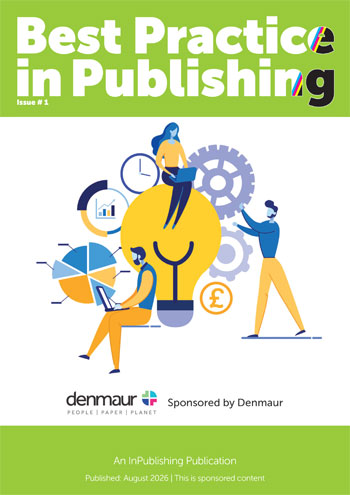
Inserted with the July / August issue of InPublishing magazine (not yet on the mailing list? Register here) was the launch issue of our new title, ‘Best Practice in Publishing’.
It contained 26 articles full of good advice. Below are takeaways from the final tranche of nine articles. (My takeaways from the first two tranches can be read here and here).
- Paper selection: “Make sure you see a dummy of your publication when considering a switch to reduced paper weight, a different paper type or even a completely different format altogether. Sample sheets can be of help, but there is nothing like a mock-up dummy to provide a visual and tactile experience before committing to a change in paper.” (H/t Julian Townsend, publishing paper sales director, Denmaur)
- Payment processing: “Treat involuntary churn as a true performance indicator. A failed payment should trigger analysis, not resignation. Publishers should understand why payments fail, how often they’re recovered, and how many subscribers are lost despite still wanting access. This is preventable revenue loss.” (H/t Thomas Darling, finance & payment product manager, CDS Global)
- Paywalls: “Treat your paywall strategy as an ongoing test, not a one-time decision. Continuous experimentation and testing are crucial. Do not assume a strategy that performed well six months ago will continue to deliver the same results indefinitely.” (H/t John Sheehy, executive director, product & market strategy, AdvantageCS)
- Picture editing / enhancement: “Look at the imaging team’s workload. Is it largely creative work or mostly repetitive toning, cropping and cut outs? And how do they handle images for online publication? The answers will quickly reveal where automation can make the biggest difference.” (H/t Derek Milne, commercial pixometrist, Pixometry)
- Print automation: “Start narrow, prove it, then expand. The temptation is to automate as much as possible, as quickly as possible. Resist it. Pick one section, ideally one with high volume and consistent content structure, and do it properly. Learn the system, build confidence, demonstrate measurable time savings.” (H/t Atex’s James Hirsz, business analyst and Sara Forni, product manager)
- Print sustainability: “Demand to see the numbers from your printer: You cannot manage what you don't measure, so everything starts with the numbers. Once you measure, you can then work in a systematic way on reduction.” (H/t Steven Renders, general manager, Roularta Printing)
- Specialist distribution: “Open up new distribution channels: As audience reading habits evolve, publishers must continue to explore new channels. Two years ago, the reader of a health magazine might logically have been found in a gym; today, that same reader may be more likely to be found at a padel court or a zero-gravity Pilates class.” (Chris Horn, managing director, Gold Key Media)
- Subscriber management: “Subscriber management works best when it is treated as a strategic function supporting the wider relationship between publisher and audience. It’s important to: 1. Get the data right and get your view clear; 2. Ensure your customers are treated impeccably; 3. Simplify the way you do that to manage expectations and maintain trust; 4. Focus on operational efficiency.” (H/t Louise McHale, managing director, ESco)
- Subscriber marketing: “Have a retention plan, not just a renewal process: Retention should be proactive. Continually enhance your subscriber value proposition through exclusive content, rewards, events and personalised engagement. Give subscribers compelling reasons to stay!” (H/t Mike Halstead, managing director, HH&S)
The digital edition of Best Practice in Publishing is available; you can also access the articles on the InPublishing website.
You can catch James Evelegh’s regular column in the InPubWeekly newsletter, which you can register to receive here.