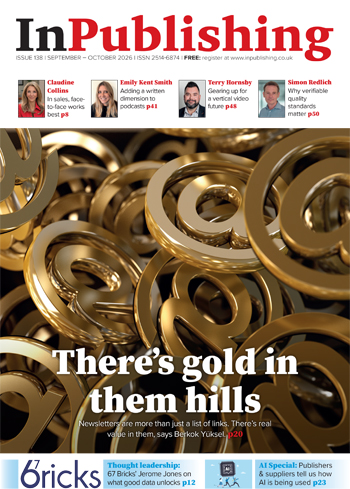
The September / October issue of InPublishing magazine was published last week (not yet on our free mailing list? Register here). Here are some of my takeaways from it, one from each article:
- Reporting climate-change: “How do you illustrate thousands of deaths from heat waves? It’s easier to show people having an ice cream on the beach.” (H/t Geoffrey Lean, interviewed by Ray Snoddy)
- Accentuating the positive: “I remember Stevie Spring once saying when she was young, her and a guy were called in by their boss. They were told there was an opportunity for one of them to work in Paris and asked, do you speak French? She said, No, I’ve only got O-level. He said, Yes, I’ve got O-level and got the job – even though while she got an A grade, he got a C.” (H/t Claudine Collins, interviewed by Meg Carter)
- Search: “Search algorithms have always evolved, usually in ways that hurt online publishers. AI search is another such evolution, and a step change if not necessarily a cliff edge. In short, too many eyeballs are now just scanning the AI summaries in Google, getting enough of what they want from those and not bothering to click the few source links that are sometimes now provided.”(H/t Dickon Ross)
- The importance of solid data foundations: “AI does not lift a weak foundation. It exposes it. Point a capable model at content that is inconsistent, poorly structured or unreliable and it will not simply return a worse answer. It will produce fluent, confident nonsense, in exactly the same assured tone as a correct one.” (H/t 67 Bricks’ Jerome Jones – sponsored content)
- Editorial skills: “The best thing you can do as an editor is to go and meet people you’re writing for because they remind you what it’s all about.” (H/t Jo Checkley, interviewed by Laura Silverman)
- Rethinking email: “Email should be treated as a platform with its own content, acquisition and monetisation strategy and not simply as a promotional tool.” (H/t Berkok Yüksel)
- AI – first thing first: “Start with the problem, not the tool: The arrival of a new model can create a powerful sense of urgency, but the best use cases usually begin with a frustrating workflow or unmet audience need. The question should be: what are we trying to improve and why would anyone care?” (H/t Toby Wiseman, in our AI Special)
- Educating future generations: “We need to encourage critical thinking by asking the right questions. Don’t accept the first answer you are given. This will provide an antidote to all the ‘brain rot’ that is out there.” (H/t Alex O’Brien, interviewed by Alan Geere)
- Vertical video: “While most publishers are well onboard the video train, not everyone has fully embraced the importance of vertical video. Over the next twelve months, I see more and more publishers adopting vertical video – a format where so much of our audience spends so much time in their daily lives.” (H/t Terry Hornsby)
- The importance of trust: “In media, we’re operating in a time of abundance: of data, ad inventory, delivery channels and, of course, content. This was not always the case. But the twin assets of trust and quality become more important, not less, as media becomes more complex.” (H/t Simon Redlich)
- On media moguls: “Kane is driven to master his world through control of communication platforms: a personality powered by dark demons; a bully obsessed by power; a weakling undermined by his own flaws and passions. It is a powerful and disturbing story.” (Jim Bilton on the fictional media mogul, Charles Foster Kane)
If you want to read the full issue, then please register here. Once you’ve completed your registration, you’ll be provided with a link to the digital edition.
You can catch James Evelegh’s regular column in the InPubWeekly newsletter, which you can register to receive here.