When Catherine de Lange was a more junior editor at New Scientist, she proposed a story about migraines. As a migraine sufferer, she wanted to understand them and thought it would make a good piece. The team agreed, but said it was too niche to make the cover. When it went online, the piece took off. Migraines affected far more people than the team had thought.
“I’m always prepared to take risks and go big on a story if I get the sense that it will interest people,” says Catherine, who has been editor of New Scientist for just over two years. “A lot of these conditions don’t get the research or the airtime because they only seem to affect a small number of people. Often, that is coded language for women. I try not to overlook the topics that are being overlooked by others.”
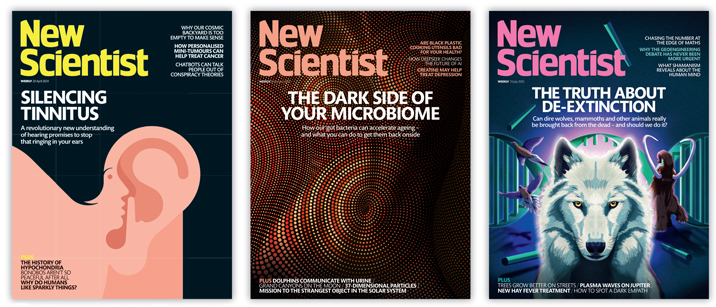
More recently, the magazine has covered tinnitus, another condition that might have been dismissed as niche. “I asked people I knew if they had it,” says Catherine. “People on the team said they got it all the time. I told my husband and he said he got it – I didn’t know!” This time, the story did make the cover. It was one of the bestselling issues of the year.
A high bar
At the latest BSME Awards, Catherine won Editors’ Editor of the Year. She was nominated for her ability to predict trends, her skill turning dense, complicated science into pieces that pull people in and her talent managing a team that consistently produces stories that make a difference.
New Scientist sets a high bar for its journalism. “We’re looking for big, bold ideas. We want to bring our audience to the cutting edge of science,” says Catherine. Sometimes, this means covering breakthroughs. At other times, it’s about running a piece that radically shifts how we think about something. Last year, the magazine ran a big story about how tumours can hack our nervous system, using it to spread cancer throughout the body. They’ve also explored the idea that you have a microbiome in your brain. “Bacteria shouldn’t get in the brain, so it’s really counter-intuitive,” says Catherine. “We’re ruthless about only going for stories that push the boundaries of our understanding. Give it five years and I suspect everyone will be talking about these ideas.”
Sometimes, going after an idea so early can be a disadvantage. Catherine remembers working on a story about the weight-loss drug Ozempic about ten years ago. “Often, we have to remind ourselves to get our head out of our own archives,” she says. “When public consciousness catches up with a topic, we’ve realised that we might need to do a topic again.”
If a subject is getting a lot of coverage elsewhere, New Scientist might run a story offering its expertise. “We cut through the noise and give the authoritative take,” says Catherine. In one issue, a reporter looked at the rise in ADHD diagnoses. In another, the cover story explored what autism might look like in girls based on a book by the neurobiologist Gina Rippon. “That issue did really well because there’s so much about autism that we still don’t understand,” says Catherine. “If you go on Google or ChatGPT, there’s going to be loads of information, but what’s reliable? People trust us to give them the real information.”
If New Scientist disagrees with a prevailing view, it is very willing to call it out. Last year, several publications reported that the dire wolf was back from extinction. “We were very sceptical,” says Catherine. “We did a very strong takedown and challenged the idea that the company making the claims were doing what they said they were doing. We scrutinised the story. We’re journalists; we’re not science communicators. We’re not here to promote science; we’re here to question it.”
Cultivating connections
Most of the team have scientific backgrounds: Catherine studied human sciences at UCL, before doing a master’s in science communication at Imperial. But they don’t come up with exclusives or hot takes just because they know their stuff. They also cultivate contacts. Reporters and editors are encouraged to attend conferences, go on lab visits and meet people face to face. “The team have really good relationships with scientists,” says Catherine. “It’s all about the access. We’re giving people the inside track.”
Often, scientists go straight to New Scientist with their ideas and their discoveries because they trust that they’ll do a great job of reporting on them. “They know that we’re really good at taking on quite complex ideas, understanding the science and showing people what it means for them,” says Catherine. Relationships might take time, but “it’s about playing the long game”. And it pays off. New Scientist journalists have had exclusive stories about people being put in suspended animation and the world’s first head transplant.
Great storytelling
Even if you do have a science background, many of the topics in the magazine are hardly light reading. Not many people are entirely au fait with the ins and outs of pioneering surgery, AI or quantum physics. Most of the audience, however, aren’t science buffs. “New Scientist is for the general public,” says Catherine. “We want people to feel that science is for everyone.”
To check that they are explaining an idea in the best way, the team employ the “pub test”. How would they tell their friends about it? Would they care? “We don’t ever want to dumb things down,” says Catherine, “but we do want to get to the crux of a story.” Jargon is out. “The rule of thumb is that anybody should be able to understand it,” she says. “We don’t use language that makes people feel stupid or left out. We’re not trying to show how clever we are.”
Good storytelling, meanwhile, is in. “We don’t want our articles to feel like required reading. If we want people to give up their time to engage with our content, it’s got to be entertaining. We’re not here to educate people. Entertainment has to come first.” Even serious subjects, says Catherine, have to be a good read. She cites a big piece by the environment reporter Maddie Cuff about how the oceans have been thrown into chaos with global warming and what that means for the acceleration of climate change. “That is not a good news story, but it was so gripping,” says Catherine. “It is a meaty, hardcore subject, but Maddie included all these brilliant examples of people who were affected. I remember sitting at a train station, getting my head down into the story and not looking up.”
Sometimes, says Catherine, you just have to embrace the topic. One of the most popular subjects at the moment is maths. “We can be unashamedly geeky about stuff,” says Catherine. News editor Jacob Aron has written about probability, the value of zero and how maths can help us win the lottery. His columns are consistently popular.
New roles, new skills
Like many titles, New Scientist is currently overhauling its work culture. Soon, all stories will go online first. The team will also be producing more digital-only features in different formats. “It’s about thinking first and foremost about the digital audience and how we fit into their life,” says Catherine.
The team are not just having a few sessions about creating videos or uploading articles; some are on multimedia secondments. “We’re giving everyone opportunities to work on different kinds of projects and to take ownership of them,” says Catherine. “I’m really keen to support people to try new things.”
During the pandemic, Catherine was put on a secondment of her own as coronavirus editor. “It was really hard, but it was one of the best things I’ve done,” she says. As well as juggling print and digital deadlines, and staying up to date with developments, Catherine learned to collaborate with her colleagues in a different way. “I had to learn how to influence the news team and work with them without being their line manager,” she says. It has helped her in her current role.
Fail fast
In the post-pandemic newsroom, innovation is now the priority. “We’re trying to work much more like a start-up,” says Catherine. “We’re trying things quickly, seeing what works, then iterating the ideas.” New Scientist has recently launched a games hub, as well as a chatbot so that you can talk to the archives. They’re also redesigning the website, partly to present long reads better, and upping their content on YouTube. “I want to give people the permission and the ability to be experimental,” says Catherine. “Most of the time these things aren’t going to work, but that’s okay. That’s how progress happens. It doesn’t always have to be perfect.”
With 10.5 million followers across its social platforms, New Scientist already has a healthy digital base. About 1.2 million people follow their Instagram account, while their videos get 61 million monthly views. “We have a really strong engagement with our younger, digital audience,” says Catherine. “Now we want to nurture that relationship.” They are keen to expand and see potential abroad. In the US, a lot of science coverage is tied to politics. People crave the impartial New Scientist approach.
As the team produces more content and experiments with different formats, Catherine is determined that standards remain high. “We can’t compromise on that quality and that expertise and that trustworthiness,” she says. “If we do, then I think things will start to fall apart. We want to create something that stays true to the New Scientist values, but do so in a more engaging way. I can’t overemphasise the size of the audience if we get this right.”
This article was first published in InPublishing magazine. If you would like to be added to the free mailing list to receive the magazine, please register here.