I didn’t intend to remain at Big Issue so long. Almost 20 years ago, I joined the Scottish edition – when there were standalone regional editions – as deputy editor. Until then, I’d spun through regional and national titles, a number of years at the NME included; I had a weekly column in the Daily Mirror in Northern Ireland and was picking up other bits in other media. I thought I’d learn some more, then move on. But Big Issue gets into you. I became Scottish editor, then, in a curious Celtic bridge, Scottish and Wales editor, then, when all editions were brought together, I became the UK editor, then editorial director.
As the economy tried to rebuild post-crash, through austerity, through referendums on Scottish independence and Brexit, through covid and lockdown and the world after, Big Issue pulsed and grew. We put on sales in the mid teens when conventional wisdom said it was impossible – YoY increase from 2013-2018 to 83,000 a week. We became part of the national conversation, something that had been a vital part of what I set out to do. We started to shape policy.
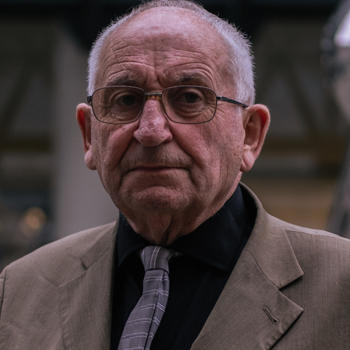
I stayed, despite other suitors floating around, in large part because of John Bird, whose outsider, challenger DNA anchors and guides everything, and because, really, of the injustice of it all, a system that felt stacked against those with least. Big Issue was a way of doing something about it. At core, that idea of a hand up not a handout, of giving vendors a chance of earning to work their way out of the worst of poverty (always remember Big Issue is a business, not a charity – no government grants, no bailouts if things went wrong, a business that lives or dies on sales) means everything. And it extends to advocating for those battered and bruised and ignored by systems built against them. Every day I felt we were tackling that, finding a way to be a voice, to let some light in.
Also, it was fun. There are not many editor chairs like Big Issue in Britain, or maybe anywhere else, with such brand awareness, with access to government and the forgotten on the street, to stars and leaders of commerce. To have the chance to shape that. Who wouldn’t want to try to drive that magic, sometimes runaway, bus.
What does an editor do?
It’s the question I’ve been asked most through the years. At core, it’s two things – people and making a decision. Of these, in any moment, making a decision is key.
People management is important, of course. It’s hardly a secret that managing up is challenging. But getting the right team, the blend that will deliver and want to go above and beyond – without that, you are nothing. I built, I think, three new teams over time, when changes came and we had to change. Each was different, according to the demands of the time, but was similar in this way – they came along with what I asked. Once you establish identity as an editor – make that tone of voice consistent and understood – then you encourage talented people to run with it. Don’t overcomplicate, be clear on who you are, what you are trying to say, who you are trying to say it to and what you want to achieve. From every caption and headline to every design choice and social post.
An editor is only as good as the people around them. I’ve been very lucky to have some incredible talent.
Making decisions is a fundamental act. You will always have dozens of things going on at any one time. I was an old school editor – a manager, rather than a coach as somebody said recently. It meant I’d be involved in conversations about commercial planning and growth, about ad strategies, about paper stock and weight, about sales and subs, about marketing, about elements around change management as much as about commissioning and story choice, about front covers and freelancers, about legal threats and the occasional D-Notice (always seek advice from wise old editor owls when you get a D-Notice). But you need to remain in the moment enough to make a decision when demanded. Many people have opinions, but few want to take responsibility for a decision. You must embrace this. And be prepared to change course if you see you’re steering the wrong one. Nothing wrong with being wrong (just don’t be wrong often). As an editor, it’s your name above the door. You’ll have to carry it when things go wrong. You’ll get plaudits when things are a success, but accept both equally.
And know you’re ultimately alone. You’ll have good people around you. I had Russell Blackman as MD for many years. He’s a good man. But accept the reality. And accept it won’t leave you. Even when you’re off, you’re not off. It’s in you. If you’re an editor like I was, you’ll have put a lot of yourself into your title. It’ll be, in many ways, a reflection of you, for good or bad. That doesn’t disconnect because you’ve decided to take a long weekend in the sun.
If that pilot light goes out, move on.
You won’t get if you don’t ask
Big Issue’s reputation brought interest and introductions. It’s a brand identity built over decades. But it only takes you so far. And in order to bring certain people, with ideas and reach and identifiability – and therefore sales – I needed to leverage it.
A guest edited edition became a mainstay over my time. Two things always surprised – those who agreed to be involved. And the terror they felt at doing it. There was always a curious reverence about what we do.
There were questions about how much work would be needed, how they would do it all, how they’d get pictures – any concern, it was raised. The instructions were the same – keep it simple. Pick a theme. That’s a start. Then we’ll take it from there. And due to the simple act of always asking, remarkable things followed.
So it was when Mark Millar, the comic book genius and a creative dervish with a million ideas a minute, went with the theme of heroes, and approached people he knew and liked to talk about or talk to their heroes. Which left me in my kitchen giving interview advice to Mark Hamill, (Luke Skywalker himself!) about how to handle Ray Davies of The Kinks. We had a great night out together after all was finished.
I ended up recording a bizarre promo clip with Armanda Iannucci after he brought his creations Malcolm Tucker and Alan Partridge back for an exclusive Big Issue conversation. Playing a prattish foil to Iannucci’s angry editor was a joyous moment. I say playing…
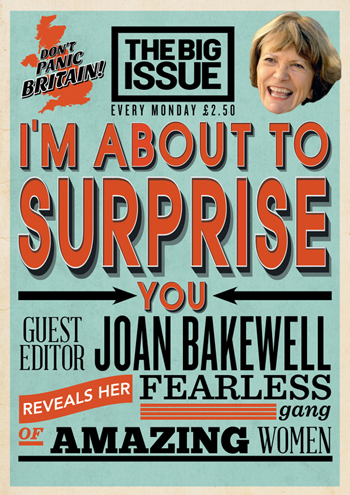
Through Joan Bakewell, another brilliant guest-editor, I got to know magazine royalty Polly Devlin. I wanted Polly to write a regular column so she invited me to her house in west London to talk it through. An early afternoon became late afternoon as she fed me champagne and houmous, talked about her daughters, told me stories about Peggy Guggeinhem and Seamus Heaney (her brother-in-law) and, maybe, about somebody living in her shed. By the time I left, unsteady, I didn’t know if she’d agreed or not. She had. Her pieces soared, of course.
When Jarvis Cocker was guest editing, just out of first lockdowns, it became clear he was a man who lived as individually as his aesthetic suggested. He could be reached on his house phone, but it was awkward for him because it was plugged in and the cord wouldn’t quite reach from the hall to the living room, “I’m perched here, Paul”. Note-taking therefore was tricky. As a gift to thank him for doing what he did, I bought him a phone cable extension lead. He appreciated that.
To illustrate the invaluable element that guest editors deliver, one of the contributors Jarvis brought was the late David Graeber. It turned out to be one of Graeber’s last pieces and remained a dominant big read on bigissue.com for several years.
A couple of years ago, I was approached by Paul Simon’s team saying he was going to do one or two interviews, Big Issue might be one, but it had to be the right interviewer. I knew there was an old connection with Paul Muldoon, so I said, how about Paul Muldoon. It came back agreed, but there was a snag. I didn’t know Paul Muldoon. I mean, I knew of him. I think he’s the greatest poet in the English language, I’m a fanboy. But I had no in. I found a Princeton university contact, I emailed him, I explained what we had and asked if he’d do it, and he said, sure, sounds like fun. And so it came together, the greatest poet in the English language interviewing one of the all-time great songwriters of the 20th century for Big Issue. I had a couple of chats with Muldoon about content and approach. Sometimes you just have to catch your breath and be in the moment.
Guest editors will also bring more than content and reach. If you allow it, they’ll help you see the world differently and make you challenge yourself more. They’ll make the publication, and all related content, better. They’ll shake it. That was the case with artists Charming Baker and the Connor Brothers. Their outsider approach and ways of seeing remain with me. This happened particularly with 10Foot. A man best known for tagging his moniker on walls and bridges from London to Patagonia, his world view, his attempt to understand the how and why of actions by everyone, his deep, abiding love of Shane Macgowan, meant he was a special character.
Design
The speculative approach can deliver deeper results. Post covid, Big Issue magazine was in a bit of a mess. We had adapted massively to survive during lockdown. Big Issue is always adaptable. Within days of removing our vendors from the streets, and destroying street sales, the entire organisation galvanised, led by recently arrived Paul Cheal – that’s some baptism of fire – to reconfigure and change utterly. It remains a low point and a high point. We went from zero to 10,000 subs in a matter of weeks. All the celebs who ever said they loved Big Issue and would do anything to help; well they were called. And so many helped, making videos, being part of an auction of money can’t buy prizes – screenwriting 1-2-1 class with Iannucci; guitar lesson with Serge from Kasabian. We were able to raise enough to keep going and to distribute over £1million in cash and food vouchers, and more, to our locked down vendors. We worked with government to get many people who had refused, off the streets. It was a dark time but it was a time of seat-of-the-pants energised thriving.
However, the mag had lost focus. We were looking for a redesign. Some names were discussed. I loved what Matt Willey had done, particularly his work on New York Times Magazine. I approached him asking if he was interested in having a look at Big Issue. Over time, we had several conversations over Teams, mostly about Manchester United, and jazz, and record covers and how pages breathe, about magazine identity. It was fascinating, but it never felt like it was a discussion on changing things. In fact, we didn’t set deadlines or sign a contract. Then, out of the blue, one Friday, he sent me a doc with over 90 pages of redesign ideas. It started by reimagining the masthead, cover treatment and every element of every page. It was remarkable. He recreated the entire look anew. It led to the creation of our bespoke Big Issue Fat font family, that is now across the brand. It rewired how I saw. And kickstarted a new fertile working relationship for me and art director Mark Neil. Establishing sympatico with a masterful art director is a key part of an editor’s role. I had two lots of working with Mark. Without him, Big Issue wouldn’t have had the hips it has.
Partnerships are very, very important
Throughout my career, there have been a number of vital people who have helped create, be sounding boards and without whom, nothing would have functioned properly.
The first was Colin Murray, now one of Britain’s best broadcasters, and a prince of a man. When we started, we were kids. We set up a music magazine called Blank in Belfast in the late 90s – he barely 20, me 24. We hustled everywhere to get money to fund the mag, playing the ceasefire, cross-community card – me working class Catholic, he working class prod. We got funding from LEDU, Princes Trust, the Ulster Bank, Red Bull and Guinness. It was a buzz. We relied on each other and from him I learnt the value of proper preparation and invention in questions.
John Bird, Big Issue founder, has been an inspirational, sometimes infuriating, always challenging leader and father figure through the years. We have butted heads many times, but he allowed me to make so many mistakes and backed me when I’m sure others wouldn’t. His advice is always straightforward and that desire of his to challenge orthodoxy is essential.
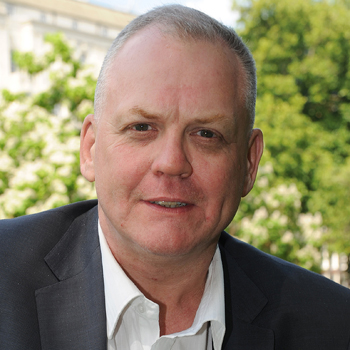
Big Barry McIlheney was in the 80s vanguard of Northern Irish journalists heading to make a name in London, paving the way for people like me. We became friends when he was PPA boss and I was a young editor.
He took me under his wing, made introductions to the right people, invited me to host events, was always at hand when I needed guidance and had a great story and off-colour joke at the turn of every day. I owe him so much. He died last May. It was a shock and I miss him, as I know many did. He’s one I didn’t get to tell about my decision to leave.
Back yourself
Somebody told me recently I’d done over 960 Big Issues. That feels a lot – though had I known it was so close, I might have held on for the 1000!
I have no great advice for young editors, or anybody finding their way in the big chair. I realised as I went on, I probably knew less and less. The best thing to do is get people in who know their brief. Don’t be afraid to say you don’t know – challenge them to come up with what they know. And trust your instincts. You’re there because you’re the best person. Have faith in that.
I was also asked recently which was the best edition I made. I haven’t made it yet. The best is always the next one. The last one isn’t good enough. So make the next better.
I’m on to the next now. No pasarán!
This article was first published in InPublishing magazine. If you would like to be added to the free mailing list to receive the magazine, please register here.