In the mid 1970s, punk music exploded as a middle finger to the overproduced, gatekept world of progressive rock. It wasn’t about being a virtuoso; it was about the ‘three chord wonder’ – the idea that if you had a guitar and something to say, you were a musician.
Today, a similar revolution is happening in technology through ‘vibe coding’ and AI hacking.
On January 24, 2023, Andrej Karpathy, OpenAI co-founder, coined the phrase, “the hottest new programming language is English” in a post on Twitter, now X.
It captured a massive turning point signalling that large language models could interpret natural human speech as operational code, meaning people no longer needed to memorise strict syntax like Python or C++ to build software.
It created a new period of creativity by lowering the barrier to developing applications and visualising ideas to share and shape into new products or improvements to existing ones as anyone who could speak or write clearly could now instruct a computer to build apps or analyse data.
Since Andrej Karpathy’s initial declaration in 2023, the concept has evolved rapidly. Karpathy himself coined the term ‘vibe coding’ in February 2025 to describe the shift from writing exact syntax to managing high-level intent. It also became the Collins dictionary word of the year in 2025, symbolising the democratisation of coding.
The DIY ethos of vibe coding
Vibe coding is a software development practice where developers describe a project’s intent in natural language to a large language model (LLM), which then generates the source code automatically, to quickly visualise and develop an idea to make it easier to explain, see, iterate and ultimately deploy. Just as the punk bands stripped music down to its rawest energy, vibe coders strip development down to its pure utility.
This shift democratises creation, moving power from those who can navigate complex compilers to anyone with a clear idea, echoing the punk zine culture where anyone with a photocopier was a journalist.
Distribution is splintering across owned channels, platforms and AI interfaces, each favouring different formats and stories.
Small publishers have seen search traffic fall by 60% over the last two years, compared with 20% or more for larger rivals. This change has prompted the brutal realisation that Google is not a business model but a channel. Accepting this fundamental change requires a pivot to less SEO-dependent models that can offset some of the damage and ideally replace it.
The strategic question is no longer how to defend search traffic, but how to test what works where, and to replace it with publisher owned direct channels.
In a modern media company, vibe coding allows non-technical experts like journalists or marketers to move beyond the constraints of a standard CMS.
AI-assisted development lets non-product teams quickly prototype structured content, tagging systems, answer-ready formats and multi-surface packaging.
A reporter can quickly ‘vibe code’ a bespoke interactive guide for a specific story or an internal tool to automate a tedious infrastructure task, such as a custom web framework for tracking house prices in a specific neighbourhood.
Producers can use AI to rapidly prototype new formats, such as turning written blog posts into conversational podcasts.
Marketing teams can generate AI-powered task schedulers or niche applications without waiting for an official engineering roadmap.
Editors can unlock previously unused content from face-to-face events or round tables to reconfigure it into new products, services and revenue.
This approach was extensively explored in the PPA-commissioned Enders report ‘Humans and Machines: The Everywhere Equation’, used as the keynote address at this year’s PPA festival in May.
The report examined the rapidly evolving media landscape shaped by digital transformation and artificial intelligence.
While technology is revolutionising how audiences discover and consume content, the report underscored the fact that the fundamentals of media success remain unchanged: trust, human creativity, and meaningful community connections.
It highlighted that audiences continue to seek belonging and authoritative voices – qualities that AI cannot replicate – making direct relationships and distinctive editorial brands more valuable than ever.
In essence, the report stated that publishers do not need to be omnipresent across all platforms to thrive. Instead, success hinges on strategic agility, multi-format storytelling, and deep audience engagement tailored to specific communities.
A standout recommendation is to embrace a ‘punk’ approach to product development – deliberate, rapid experimentation that thrives on uncertainty and challenges traditional, slow-moving processes. The report detailed how AI-assisted tools now allow even non-technical teams to prototype and test new formats, workflows, and audience strategies quickly and cheaply. This punk mindset, is enabling organisations to adapt at speed, learn from failure, and build the processes and infrastructure needed for future resilience.
Work that once sat behind engineering queues is therefore becoming cheaper, faster and more accessible, with the new opportunity of running many small experiments inside clear brand guardrails, rather than bet on a single large build.
But prototypes are not products. Scaling them into reliable infrastructure still demands deliberate investment in data architecture and engineering.
By the middle of this year, 2026, there was a realisation that vibe coding was risky for production software and has now shifted into a new phase called the ‘Manager Era’, where agentic engineering or ‘harness engineering’ supplements ‘vibing’, though the building of harnesses or automated testing loops and constraints – that force AI agents to verify their own work.
So the human builds the system that supervises the AI code.
This is where the concept of the appropriation cycle becomes an important part of adopting vibe coding into a wider, scalable enterprise approach.
It builds on the idea championed by Jamie Reid, an English visual artist and anarchist whose provocative cut-and-paste graphics defined the visual identity of the punk rock movement.
Reid famously said that, “radical ideas will always get appropriated by the mainstream, you always have to move on and on”.
So, the appropriation cycle, an idea developed at William Reed, embraces the concept that today’s vibe coding ‘punk’ experiment will likely become tomorrow’s core infrastructure.
There are four steps in the appropriation cycle:
- The rogue experiment: A journalist uses vibe coding to build a disposable, one-off interactive tool to bypass the rigid CMS.
- Audience validation: The tool goes live and drives better than normal and unexpected audience engagement.
- Mainstream appropriation: Internal product teams notice the success, formalise the code and integrate it into a product roadmap.
- The next rebellion: Creators freed from that problem, begin vibe coding the next format.
The Sex Pistols vs Pink Floyd: a tale of two charts
This difference between vibe coding and traditional engineering is best illustrated by the contrast between a punk anthem and a progressive rock masterpiece.
- The ‘Pink Floyd’ approach (traditional engineering): Like the meticulously layered, 17-minute tracks of Pink Floyd, traditional coding is about total control, deep architectural insight, and long-term stability. It is essential for mission-critical systems like online banking platforms, where every line must be verified for security and scalability.
- The ‘Sex Pistols’ approach (vibe coding): A vibe-coded app is like the Sex Pistols’ ‘God Save the Queen’, it’s fast, loud, and designed to make an immediate impact. It doesn’t care if it’s polished or built to last a decade; it’s about validating an idea now.
Both reached the top of the charts, but for different reasons: one for its enduring craftsmanship, the other for its disruptive energy.
Why we need both: the suit and the safety pin
While the ‘punk’ approach is essential for innovation, it works best when it disrupts a stable foundation.
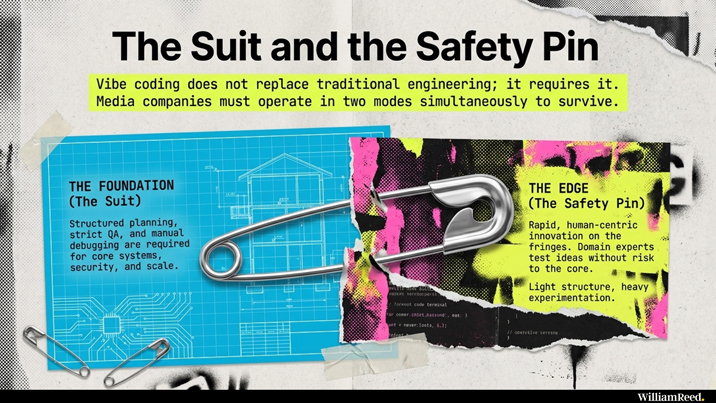
Vibe coding does not replace traditional engineering, it requires it! To really take advantage of the opportunities vibe coding creates, media companies need to start operating in two modes simultaneously to survive. William Reed has dubbed them ‘The Suit’ and ‘The Safety Pin’
- The traditional approach: The suit or foundation with the disciplines of structured planning, quality assurance and manual debugging for software that needs to scale, stay secure, and remain maintainable over years. In essence, the suit encourages control, deep architectural insight and long-term stability.
- The punk approach: The safety pin or rapid human centric innovation on the fringes where domain experts test ideas without risk to the core for rapid prototyping, creative expression, and challenging corporate thinking. In essence, the safety pin encourages fast, loud and immediate impact conceived, prompted and validated in hours or days.
William Reed’s approach is to build its AI strategy around an ‘AI-enabled, human-led’ philosophy. Instead of chasing generic artificial intelligence or viewing it as a threat, the business treats AI as a powerful enabler to unlock and amplify its true competitive advantage. Its operational mantra is, ‘AI in the workflow, humans in the byline’.
Adopting this punk mindset, William Reed held its first AI-focused hackathon in May this year.
A hackathon is a fast-paced, short-term event where people work together in teams to build new ideas, solve problems, or create working software prototypes from scratch.
At the event, ten teams of three people were set the task of prototyping and building a proof of concept for ten key projects in a day.
These prototypes include tools to assist the development of production workflows and progress reporting for stakeholders, unifying content from media brands and face-to-face events, a self serve reporting portal for clients to track campaign effectiveness and demonstrate value and a sophisticated sales proposal tool. The results are being built internally now for introduction into the business during this financial year.
As the media industry approaches ‘Google Zero’ in 2026 and beyond, brands must do vastly more with the audiences they already have, which was the central message of the PPA’s ‘Humans and Machines’ report.
The path to stronger reader relationships and meaningful engagement now runs through experimentation as much as execution.
Having a punk or ‘The Safety Pin’ approach to coding keeps the technology human-centric.
As Karpathy puts it, “where you fully give in to the vibes, embrace exponentials, and forget that the code even exists”.
Vibe coding, in Karpathy’s telling, is the model writing the code while the human steers by feel and quick checks. Speed is the upside; the cost is that someone still has to decide whether the software actually works, which gets harder once security and compliance teams are in the room.
It reminds us that tools serve our imagination, not the other way around. Without the ‘vibe coders’, AI risks becoming a cold, corporate monologue.
With them, it becomes a loud, messy, and inclusive conversation. But it must work alongside ‘The Suit’ which encourages control, deep architectural insight and long-term stability.
You can watch a video reel about William Reed’s hackathon here.
This article was first published in InPublishing magazine. If you would like to be added to the free mailing list to receive the magazine, please register here.