Philip Collins is relishing his first role as an editor after a varied career – banker, speech-writer (for Tony Blair no less), columnist, author, policy wonk – most of which has been steeped in political debate and thinking. Collins succeeds Alan Rusbridger at the helm of left-leaning monthly title Prospect which celebrated its 30th anniversary last year.
His ambition is to further grow the brand digitally and through events whilst retaining the magazine’s distinctiveness as a space for calmer and more reflective political and cultural debate. “We do have that luxury of a little bit of a slower turnaround,” he says. “We don’t need to care all that much about whether Wes’s (Streeting) people are briefing that Andy Burnham’s an idiot.” Collins add that being a monthly also offers the opportunity to take some of the heat out of charged political debates. “You’ve got to have the ability to go back with a rational argument against your opponent, not an emotionally charged argument… You’ve got that opportunity with a monthly to calm down.” And, he believes, there is room for Prospect to grow and prosper with and not at the detriment of other centre-left media brands such as the New Statesman and the Observer.

Collins wrote for Prospect when it first launched in 1995 whilst he was running a think-tank – “it was quite a hard taskmaster, which is a good thing, and it got some good writing out of me”. His involvement became more strategic when he was invited by the proprietor Sir Clive Cowdery to think about the future of the title a few years ago. This led to Rusbridger’s appointment in 2021 which according to Collins “was a really big statement of Clive’s continuing commitment to the magazine”. Following Rusbridger’s decision to stand down late last year, the “stars aligned” for Collins to take over as editor.
He inherits a brand with a healthy audience – over 40,000 print and digital subscribers – but “it is not without its travails” in terms of flat circulation and increasing costs. As Collins sees it, the title has two main challenges – one commercial and one “intellectual”. For the latter, it is about establishing a clearer and more distinctive identity for the magazine.
Articulating a core mission
Collins wants Prospect to “have a view of the world” and to have a core mission and defined themes that it “will keep coming back to and that’s the side we’re on”. In essence, this is the wider public debate summarised by Collins as between, “those people who regard the institutions and procedures of liberal democracy as a great gift and those who want to in some way to smash them up” – with Prospect full-throatedly behind the former.
This clearer identity will not be a rigid straitjacket, Collins insists, and he actively wants to hear more from the other political side – “I’d be quite interested in having somebody put the case for Reform” – both in the magazine and via events. He is in talks with the Spectator about a series of live debates where the two sides will be pitted against each other and (with his tongue in his cheek) “we will win”.
Whilst preaching “evolution not revolution”, Collins wants to restructure and reorder the magazine into more a “journal than a general interest magazine” starting the magazine with an editorial and columnists, a diary and letters. The editorial “won’t exactly breathe fire and brimstone, but it will have a strong view of the world… you’ll be very clear quite quickly where we stand on things.” And Collins envisages a much livelier letters page in Prospect akin to the London Review of Books (LRB) with “arcane disputes between academics… over an interpretation of a particular page of Jane Austen… I’d love to get some of that kind of fire in the letters pages.”
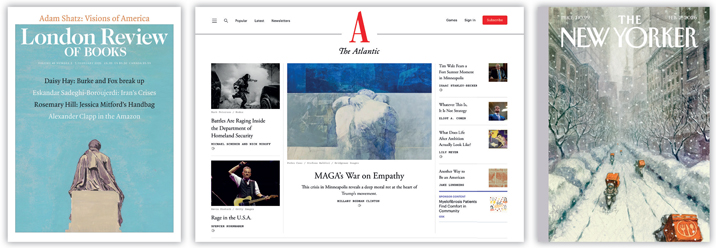
Collins sees a template for growth in titles such as the Atlantic in the US – profiting from its strong brand to generate revenue from “what is essentially an intellectual salon”. This will be via sponsored events which he has experience of running whilst working at think-tanks such as the Social Market Foundation and Demos. These events will be tied thematically to its editorial focus and can take place at or near the Prospect HQ, “in the heart of where policy conversations happen”. “We are well placed metaphorically and literally to capitalise on that,” he says.
He sees the need for changes most in the digital space but is “less sure about what they are yet”.
He wants a clearer strategy of how digital unfolds as the month progresses, culminating in the issue, pointing to the need for a more distinctive digital subscriptions offer compared to print in a very competitive landscape.
Part of this is convincing people to pay for online content – “you still find irritation amongst people when they hit a paywall in a way that you never would for print.” Collins also sees opportunities to grow digital extensions in audio as well as on platforms such as YouTube, TikTok and Apple.
Grow the reach
There’s an opportunity to grow the Prospect audience both demographically – amongst under 50s – and with readers outside of London and the South-East, Collins thinks. “We should report from around Britain more,” he says. “We should go to other places and I would love to get Prospect further afield. It’s barely a presence in some parts of the country. It’s not a viable strategy for the kind of politics we espouse either… that’s a mirror of what’s happened more widely in society, the polarisation of the politics out of those regions, the regions I came from (Collins was brought up in Bury).”
Collins stumbled into politics “by accident” when he took up a role working for Labour MP Frank Field having originally wanted to be an academic historian. He was immediately intoxicated by working in Westminster and built friendships with then up and coming New Labour figures such as the Miliband brothers, Andy Burnham and James Purnell. He admits his career has been largely driven by “sheer boredom” and “a complete inability to recognise that there are professions I shouldn’t be able to do.”
“I always assume if I try that, it’ll be all right,” he adds.
Whilst this is his first editing job, Collins has considerable journalistic chops having been a prolific columnist and leader-writer, most notably at the Times for over a decade. He’s most excited about two aspects of his new role – commissioning and hands-on editing. For the former, he’s scouting for new talent, mainly online. “I’m starting to cast people, so that’s very interesting.” In time, Collins would like to employ staff writers at Prospect – like titles such as the New Yorker and the LRB.
Collins loves the process of line by line editing which is “a lost art in British journalism”. “When I started at the Times, which seems like another era (in 2010), there would be three people on the desk who would edit my columns, and they would really edit it… and make it better.” When Collins left the Times, editing had “pretty much disappeared”. And whilst AI can perform some tasks brilliantly it’s ability to write at this point is “mediocre”. “It’s all just the same. There’s no variation. It’s just really relentless.”
More broadly, Collins bemoans the state of political journalism as being in the poorest state in his lifetime. He lists reasons for this, from the fragmentation of the media to lower budgets and the demands for speed over thought driven by online publishing. “I think there’s not the money in it, to have the distinguished jobs that there used to be… It’s not that the people are worse, it’s not that they’re more venal or anything like that. The circumstances have created a journalism which is worse. And there is much more rubbish published than there used to be.” And this is across the spectrum. “I’m not making a particularly political point,” he adds.
Collins is similarly critical of comment pages in national newspapers, calling them “boring” as they more rigidly hold to the title’s political hue. He was a victim of this phenomenon at the Times being taken off their comment pages in 2020 which he describes as a “straightforward piece of politics”. He declined a different role at the paper and decided to move – he emailed colleagues saying: “I’ve been told I need to be more plugged into the government. Frankly, I’d rather be plugged into the mains supply.”
He is concerned about free speech and censorship having previously thought journalists to be “quite pious” about being “bastions of democracy”. “The free speech problem is really material and serious,” he says. “It comes from both sides, because there’s self-censorship that comes from the left and then there’s an attack from government that comes from the right.”
Collins perceives that self-censorship has declined more recently. “I don’t think people feel quite the same trepidation on some questions that they did even a year ago.” However, the behaviour of authoritarian governments is a significant worry. “We've got people in our politics thinking that’s something to emulate. And so I do worry about that very much… that’s obviously something you’ve got to stand against.”
Whilst identifying the negatives in the current media landscape, Collins is “not despairing about it”. The fragmentation of the media that Collins perceives can also offer an opportunity for titles such as Prospect. “There are lots and lots of small circulation online magazines which are full of life and verve. So I actually think there’s a prospect of consolidating some of that, bringing it together under a respected title,” he says.
This article was first published in InPublishing magazine. If you would like to be added to the free mailing list to receive the magazine, please register here.