Amid global geopolitical turmoil and economic uncertainty, the promise made at the soft launch of The Nerve by its five co-founders – to deliver a strong progressive media platform offering a blend of culture and journalism that connects the dots between arts, tech and politics with content open and available to all rather than paywalled – struck, well, a bit of a nerve.
As news of the idea spread, established names including Stewart Lee and Philippa Perry, Michael Sheen, John Sweeney and Peter Geoghegan signed up to contribute while others, including former Observer and Guardian US editor John Mulholland and Branko Brkic, founder of South Africa’s Daily Maverick, stepped up to advise.
Within a week of launch, say the publishers, the beta website and twice-weekly newsletter had exceeded its first-quarter target of 10,000 free subscribers – including 1,000 paid subscribers – with readers drawn from across the UK. Three months on and 12% of its subscribers are paying, the newsletter has an open rate of just over 60% and the website has an average dwell time of three minutes 21 seconds.
Now, as The Nerve enters its post-launch phase, plans for this year include a full website, biannual print publication, multimedia expansion (notably including its first podcast, also more video) and a full events programme. With a sound commercial model in place, they will then seek third-party impact investors. Also on the agenda is a push into the US.
“Revenue success is the crucial aspect that’s meant we’re a viable project,” says The Nerve Co-Founder Sarah Donaldson. “Even so, the engagement metrics across the board are what’s really delighted us because they point to long term sustainability.”
Initial planning
Not bad going for an idea that started off as bit of a gamble.
To re-cap, briefly, there were two driving motivations behind The Nerve.
The first was a reaction to what happened when ownership of The Observer, where four of The Nerve’s co-founders – Imogen Carter, Jane Ferguson, Lynsey Irvine and Donaldson – were employed and worked on culture magazine The New Review. The fifth co-founder – award-winning investigative journalist Carole Cadwalladr – was a regular and longstanding Observer contributor.
All had worked together for years, including on The Observer’s 2018 Cambridge Analytica investigation, so trusted each other. All were also women, though Donaldson insists rather than part of any conscious “female founded” strategy, this was simply the result of natural self-selection. And when Guardian News & Media announced its plan to hand The Observer to Tortoise Media, Donaldson says, all questioned the commercial plan and began to explore different models that might enable the journalists to take ownership of The Observer.
“In doing these exercises, we spent a lot of time thinking how this feels like a real moment in the media – a point when building a title with Google search and social media, as Byline Times and The New European did, no longer feels a model you could rely on,” she recalls.
“It felt that to start something, you need to be voice-led, small to start off with to build an audience, and very low cost. And from that, a group of us thought, well, maybe we should take a gamble and do it.”
The ‘it’ was an idea for a new publication to bring audiences the best coverage of the UK’s world-leading culture industry – promoting artists in the broadest sense of the word who help make sense of today’s seismic global, national and local political movements.
Pressing need
The second motivation was ideological: the belief there was a market gap for a strong progressive independent media brand – and a pressing need to fill it. The Nerve is named after the essential quality the founders believe such a title in today’s turbulent world needs.
“The feeling was, this is a moment that people need to be able to read journalism for free because we are at a crucial moment. And what’s still incredible to me is that no-one even then could predict quite how quickly world events would move,” adds Donaldson.
To realise their plan, the five decided to personally fund The Nerve’s launch – with the four ex-Observer employees drawing on their redundancy payments.
With their age and experience, longstanding working relationships combined with Carole Cadwalladr’s profile, network, contacts and reach via her personal Substack, social media and other projects, they felt able to take a risk they might not have otherwise had they been in their twenties or thirties (all are over 40).
Business model
The hybrid business model they settled on arose out of a variety of observations.
The founders liked Substack’s newsletter model, which works well for many independent journalists, but decided an initial website plus newsletter offering would be better for a masthead proposition with a team of editors and contributors, for example.
They liked the idea of grants and foundation-funding which supports the work of many journalistic investigation projects across Europe, too, but they did not believe such funding alone would be commercially sustainable. And when it came to advertiser-funding, they kept it out of initial projections, Donaldson says, as it’s “so capricious it just can’t be relied on”.
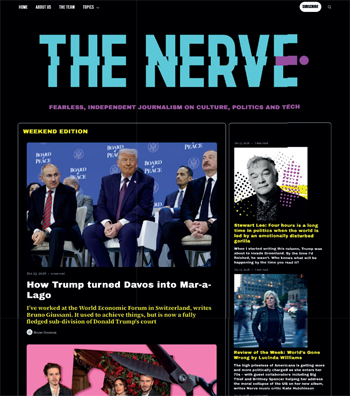
So, they chose to start The Nerve as a beta website and newsletter – using Beehiiv, the newsletter hosting platform now positioning itself as a place where creators can build full websites, sell digital products, integrate podcasts and YouTube feeds and research audience analytics – with two batches of stories delivered direct to subscribers’ inboxes each week.
And they launched with a Guardian-style membership proposition. While free subscribers can see content, those who pay – ‘members’, at either £6.95 per month, £68 per year or £250 yearly for founder membership – can access benefits including live events.
Since then, The Nerve has run some advertising for certain brands available to it via Beehiiv’s advertiser network, though eventually it will develop its own brand partnership approach. And it has attracted some core grant funding for news projects and multimedia expansion from a foundation, further details of which are yet to be formally announced.
“We really wanted to demonstrate there is a commercial model for journalism because if there isn’t, then journalism becomes a charitable kind of profession and that is really dangerous for society, I think,” Donaldson says.
Plans for 2026
To this end, two big jumps The Nerve wants to make by the end of this year are launching a print iteration and leaning further into video as a way of growing its audience and reach.
“One of the things we knew from the beginning was, we wanted it to be design-led and have print as part of the strategy,” she explains.
So, the idea is for a stand-alone quality publication with original rather than re-purposed content, some of which may then also appear in other channels, which acts as a brand add-on and earns its shelf life to satisfy demand for an analogue reading experience – amongst younger groups, especially.
“The key is not to have all your eggs in one basket,” Donaldson continues.
“The potential of Google search and social media may be less than it was, but these things do still work. Many people have come off X and I understand why, but there’s still an incredible network of interesting, smart people on it and you can still get news there ahead of everywhere else – so that’s working, but as just one strand.
“Blue Sky is incredible for us with an incredibly engaged readership and Instagram for more cultural content, too. We’ve already launched a YouTube channel which we will build on and, so far, it is going well.”
Another priority for this year is expanding The Nerve’s contributor base and, hand in hand with this, building a network of trusted expert voices – some journalists, others not.
Erosion of trust
When one right-wing news title publishes a leading story which is then followed up by others, then subsequently shown to be untrue, it damages all journalism – including the great journalism that some of the reporters on those same titles are also doing, contributing to an overall erosion of trust, Donaldson stresses.
“This is partly why analysts have this line about audiences turning increasingly to trusted voices rather than institutions,” she continues. It’s why a growing number of big media companies’ media strategy now involves turning their journalists into recognised multimedia commentators, too. “And it’s why we feel that there is a real gap for fearless, independent, progressive journalism.”
Also on the agenda is evolving The Nerve into a fully multimedia proposition capable of producing full, 360-degree investigations – like The Observer’s Cambridge Analytica investigation, which straddled news and features in print and online, multimedia including film, and social.
Building The Nerve’s audience moving forward isn’t just about growing its content, however.
“What’s brilliant about the newsletter format is that it allows you stronger interaction in a more direct, instant way than comment threads on websites – people just press reply and tell you what they think or ask you something,” says Donaldson.
It also breaks what she calls “the old them and us hierarchy”, which is something The Nerve also intends to achieve through an expanding events programme.
Recently, for example, it became media partner for The Laugharne Weekend – an annual literary and arts festival in west Wales – and other tie-ups with national, regional and local cultural organisations will follow. Meanwhile, a film screening programme is also in development.
“What’s been great is to find a real thirst for a sense of community and journalism with deeper engagement and greater interaction – not just in London but around the whole country,” she adds. “As The Nerve grows with its readers, shaped by what they want, this is something we are determined to build on.”
This article was first published in InPublishing magazine. If you would like to be added to the free mailing list to receive the magazine, please register here.